
Shanghai Micro Electronics secures an 110 - million - yuan lithography machine order


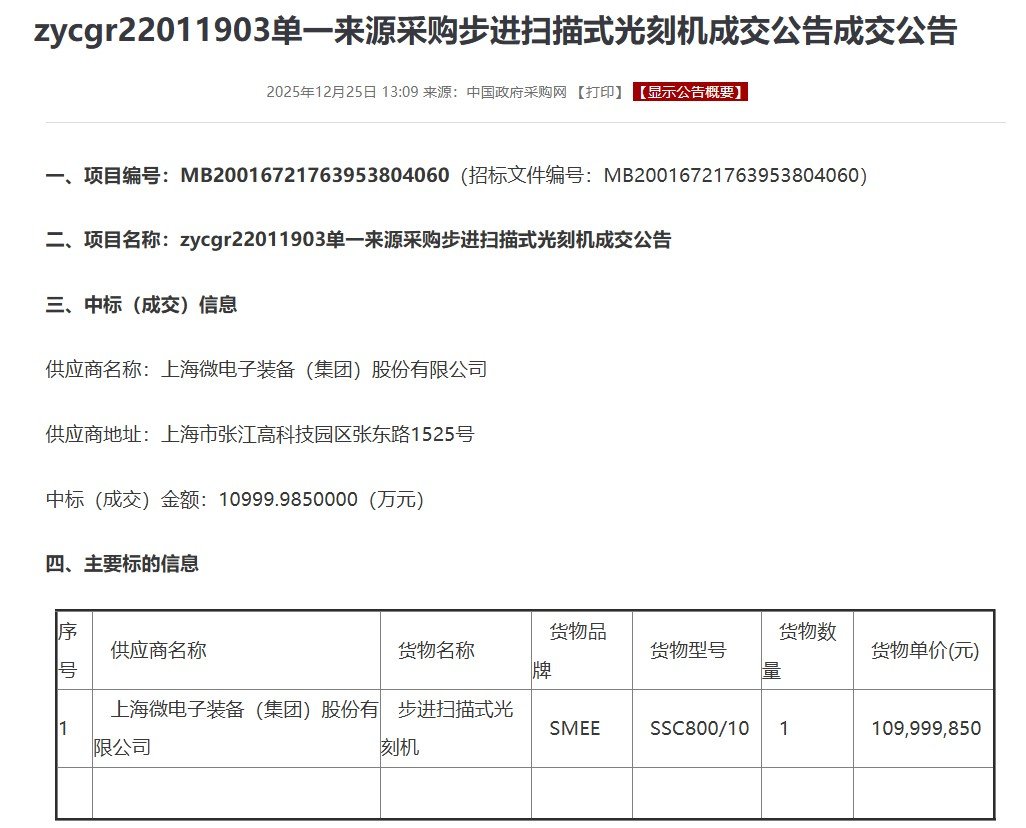
According to an announcement on the Chinese Government Procurement Network, Shanghai Micro Electronics Equipment (Group) Co., Ltd. recently won the bid for a lithography machine procurement project worth nearly 110 million yuan, marking substantial progress in the practical application of domestically developed high-end semiconductor equipment.
Recently, an announcement released on the Chinese Government Procurement Network indicated that Shanghai Micro Electronics Equipment (Group) Co., Ltd. had successfully won the bid for a lithography machine procurement project valued at nearly 110 million yuan. This news not only marks substantial progress in the practical application of domestically developed high-end semiconductor equipment, but also reignites confidence in the capital market regarding the independent and controllable capabilities of the local industrial chain.
As indicated in the public notice, the winning bid equipment is an SSC800/10 step-and-scan lithography machine, with a transaction price of 109,999,850 yuan. The equipment will be used to support the production line construction of a key domestic scientific research or manufacturing entity, and its delivery and deployment are expected to further enhance China's manufacturing capabilities in the mature process node segment.
As a leading enterprise in China's lithography equipment sector, Shanghai Micro Electronics Equipment (Group) Co., Ltd. has long focused on the R&D and industrialization of semiconductor and pan-semiconductor equipment since its establishment in 2002. Currently, it has developed technical capabilities covering process nodes of 90nm and below.
According to the official website of Shanghai Micro Electronics Equipment (Group) Co., Ltd., the company currently has five major lithography equipment series: the SSX600 series lithography machines, the SSB500 series lithography machines, the SSB300 series step-and-repeat lithography machines, the SSB200 small-mask series exposure systems, and the SSB200 large-mask series exposure systems.
Against the backdrop of escalating external technological blockades and growing global supply chain uncertainties, domestic wafer fabs have significantly accelerated the pace of validation and adoption of homegrown equipment. Analysts point out that with the continuous expansion of mature process capacity and the rising demand for chips driven by downstream applications such as AI and automotive electronics, domestically-developed lithography equipment is entering a critical window of transition from "being usable" to "being reliable".
As one of the important shareholders of Shanghai Micro Electronics, Zhangjiang Hi-Tech saw its stock price strengthen markedly on the trading day following the announcement, with intraday gains once approaching the daily limit. This reflects investors' high expectations for breakthroughs in China's core equipment technologies.
At the same time, the industry's technological roadmap is advancing steadily. Beyond the equipment awarded in this tender, industry rumors suggest that Shanghai Micro Electronics' 193nm ArF immersion lithography machines have entered the internal testing phase at leading foundries like SMIC, targeting the 28nm process node. In the more cutting-edge EUV segment, despite multiple technical barriers including light sources and optical systems, phased progress has been achieved in the R&D of relevant prototype machines.
Policy-level support cannot be overlooked either. Recently, the Shanghai Municipal Government has rolled out a number of initiatives to strengthen the local integrated circuit industry ecosystem. These include enhancing the layout of computing power infrastructure, encouraging research into key technologies, and providing substantial rewards to enterprises that obtain major certifications. These measures have created a favorable development environment for equipment manufacturers.
Challenges, of course, still persist. As one of the most complex and precise pieces of equipment in semiconductor manufacturing, lithography machines require long-term operational validation to improve their performance stability, yield control capabilities, and compatibility with the entire production line. Nevertheless, the landing of this 110-million-yuan project is undoubtedly a positive signal—it is not merely a commercial order, but also a powerful testament to the trust that users have placed in domestic equipment.
Looking ahead, with the advancement of more similar projects, China's semiconductor equipment industry is expected to secure a more solid position in the global value chain. And this step taken by Shanghai Micro Electronics may well mark the starting point toward higher technological standards and larger market shares.